
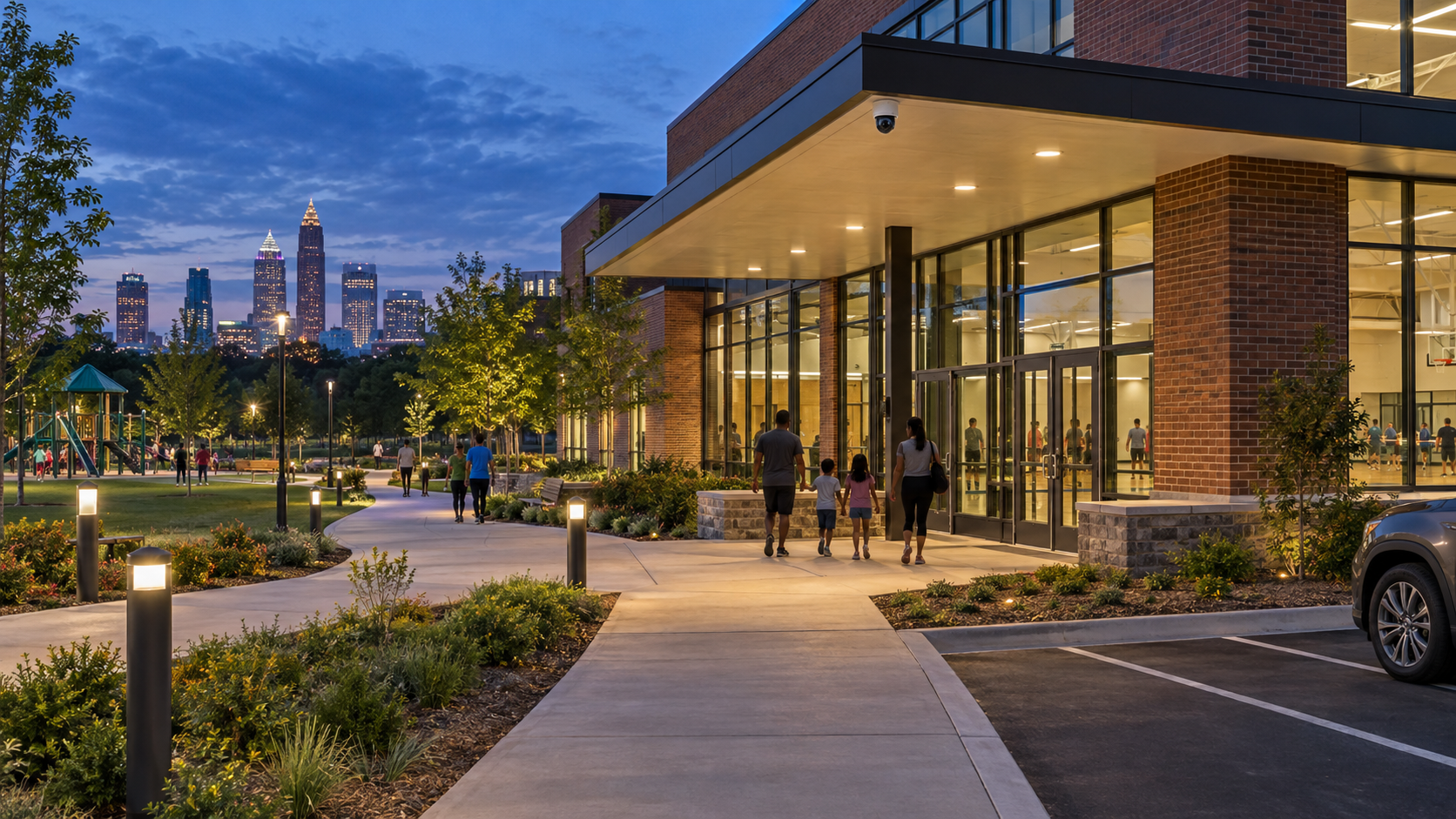
Recreation Centers and Public Parks Require More Than Basic Surveillance
Community facilities must protect visitors, employees, equipment and public spaces without disrupting access. The strongest approach connects surveillance, perimeter visibility, access control, lighting and reliable communications into one coordinated security infrastructure.
Open public access creates security challenges that private buildings do not face.
Recreation centers, athletic facilities and public parks welcome a changing population throughout the day. Employees may need controlled access to offices and equipment rooms while visitors move freely through entrances, activity areas, parking lots and outdoor spaces.
Security planning must account for normal visitors, scheduled programs, deliveries, contractors, after-hours activity, special events and emergency access. A collection of disconnected cameras cannot manage that operational complexity by itself.

The greatest vulnerability may exist outside the building.
An effective assessment must examine how people approach, enter, use and leave the property—not only what happens at the reception desk.
Parking and Arrival Areas
Poor lighting, blind spots and limited camera coverage can reduce visibility where visitors and employees enter or leave the property.
Multiple Entrances
Side doors, staff entrances, service areas and emergency exits may not receive the same oversight as the primary public entrance.
After-Hours Activity
Outdoor spaces may continue attracting activity after staff members leave and the main facility closes.
Equipment and Storage
Maintenance rooms, technology cabinets, athletic equipment and inventory require stronger access controls than public areas.
Large Public Events
Attendance surges can change normal traffic patterns, increase entry points and place additional pressure on staff.
Disconnected Systems
Cameras, doors, networks and lighting may operate separately, slowing investigation and creating unclear response responsibilities.

Separate public access from protected operational areas.
Recreation centers need to remain accessible to the communities they serve. That does not mean every visitor should be able to enter employee offices, storage rooms, technology spaces or maintenance areas.
A properly planned access-control system can help authorized leadership define who may enter restricted areas, when access is permitted and how credential activity is documented.
Build visibility from the property boundary to the protected room.
Effective community-facility security connects multiple systems around actual operations. Each layer should support the others instead of functioning as isolated equipment.
- Perimeter and parking-area surveillance
- Entrance, exit and reception-area camera coverage
- Access control for employee and restricted spaces
- Commercial lighting that supports visibility and camera performance
- Structured cabling and reliable business-network infrastructure
- Appropriate recording, storage and evidence-retrieval procedures
- System-health notifications and maintenance planning
- Clear alert ownership and escalation procedures
- Scalable infrastructure for future cameras, doors and facility growth
Can your current system answer these questions?
- Who entered a restricted area and when?
- Can nighttime video produce usable evidence?
- Are parking and exterior activity clearly visible?
- Can former staff credentials be disabled immediately?
- Who receives camera, door or network failure alerts?
- How quickly can authorized staff retrieve video?
- Will the system remain useful as the facility expands?
Protect the facility, the people and the public experience.
Mounted Up helps Atlanta organizations assess and integrate surveillance, access control, commercial lighting, structured cabling, networking and unified security technology.
Recreation center and public park security FAQs
What security systems should a recreation center consider?
Appropriate systems may include CCTV surveillance, access control, commercial lighting, structured cabling, business networking and reliable recording infrastructure. The correct combination depends on the facility, operating schedule, public access and identified risks.
Can access control be used without restricting normal visitors?
Yes. Public entrances can remain accessible during operating hours while access control protects employee offices, equipment storage, technology rooms and other restricted areas.
Why should exterior lighting and surveillance be planned together?
Camera performance depends heavily on lighting conditions. Glare, darkness and uneven illumination can reduce image quality even when the camera itself is functioning properly.
Should public parks include perimeter surveillance?
Perimeter monitoring may improve visibility around entrances, parking areas, pathways and other priority locations. The system should be designed around authorized operational requirements, site conditions and applicable policies.
Does Mounted Up support complete commercial infrastructure?
Mounted Up supports CCTV and surveillance, access control, commercial lighting, structured cabling, business networking, Wi-Fi infrastructure, server installation, system upgrades and integrated commercial security technology.
This article provides general planning information. No security system can prevent every incident or guarantee a specific outcome. System design should reflect site conditions, authorized organizational requirements and applicable policies and standards.