
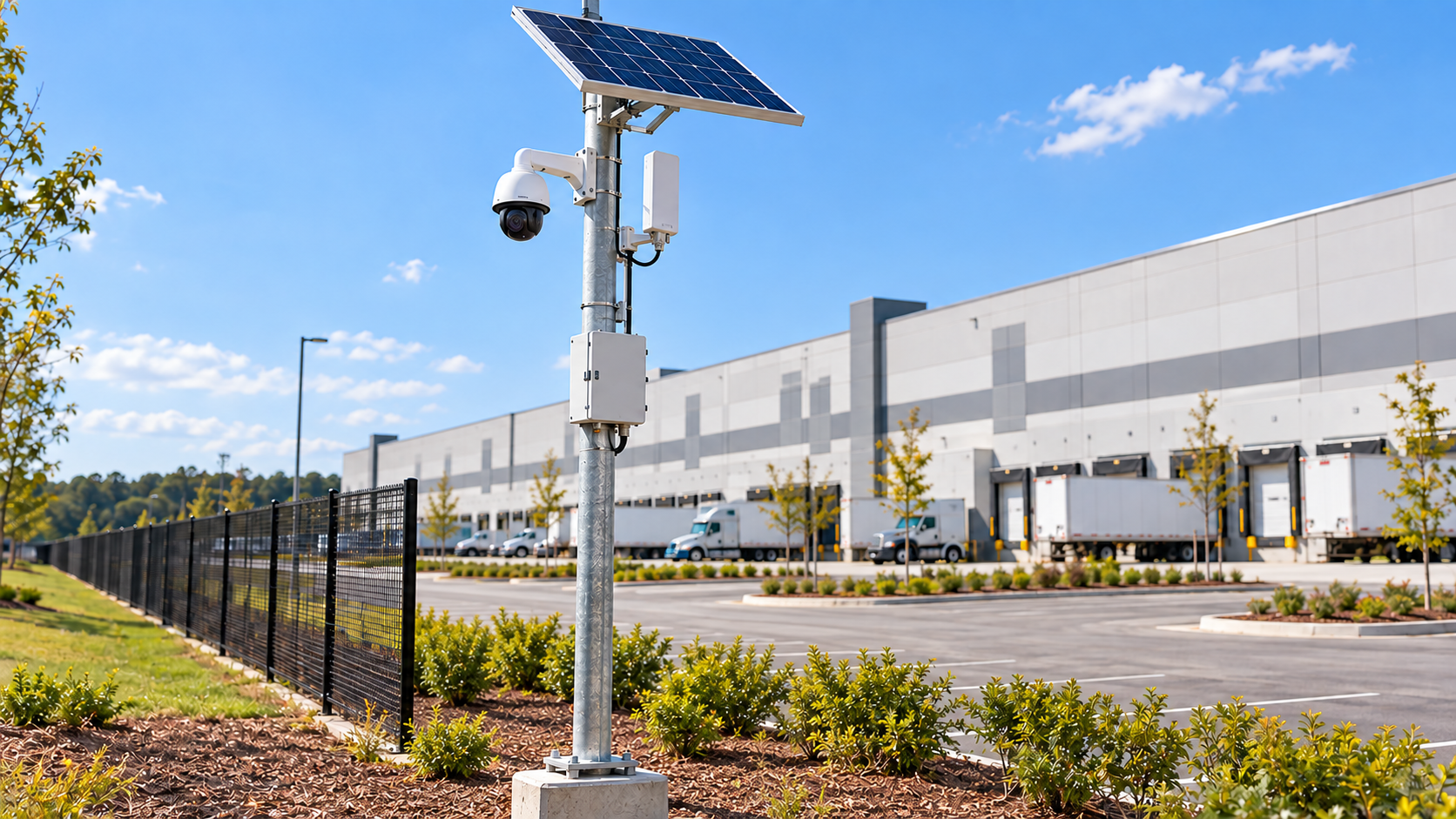
Solar Camera Infrastructure: Plan the System Before the Installation
A solar camera is not simply a camera with a panel attached. Reliable performance depends on sunlight, power demand, battery capacity, mounting, wireless connectivity, coverage and maintenance access working together as one commercial infrastructure system.
A seamless installation begins before equipment reaches the property.
Solar-powered cameras can extend visibility to parking areas, gates, yards, construction zones and remote property boundaries where conventional power or network cabling may be difficult to reach.
But convenience depends on planning. A panel placed in seasonal shade, an undersized battery, weak wireless connectivity or a poorly selected mounting position can create unreliable coverage and expensive rework.

Six decisions that should be settled before installation day
Clarifying these requirements early creates a cleaner scope, a more efficient installation and fewer surprises after commissioning.
Coverage Objective
Define the gate, lane, perimeter, equipment area or activity zone that must be visible before selecting the camera position.
Solar Exposure
Evaluate sun direction, buildings, trees, seasonal shade and future obstructions that could reduce daily charging.
Power Demand
Calculate camera, wireless, heater, infrared and accessory loads rather than sizing the system from the camera alone.
Battery Reserve
Plan for nighttime operation, cloudy periods, temperature conditions and the required level of continuity.
Connectivity
Confirm whether cellular service, point-to-point wireless or another approved connection will carry video and system data.
Service Access
Position equipment so authorized technicians can safely inspect, clean, test and replace components when required.
Every component has to support the same operating objective.
Separating equipment decisions can create mismatched capacity and unclear responsibility. A commercial solar camera installation should be planned as a complete operating system.

What should happen from assessment to commissioning
- Document the business risk and exact area requiring visibility
- Conduct a physical site and solar-exposure assessment
- Confirm camera view, mounting height and identification needs
- Calculate total equipment load and battery reserve requirements
- Test wireless or cellular connectivity at the intended location
- Define foundation, pole, enclosure and weatherproofing requirements
- Confirm recording, remote access and authorized user needs
- Document equipment placement before installation begins
- Commission the full system under daytime and nighttime conditions
- Assign maintenance, alert response and system-health responsibilities
One site plan. One equipment schedule. One defined outcome.
Leadership, installers and technology partners should work from the same documented scope. The plan should identify where equipment will be mounted, what each component supports, how connectivity will function and what successful commissioning looks like.
That creates fewer assumptions, fewer change orders and a faster path to reliable coverage.
Where solar-powered surveillance can add strategic coverage
Construction Sites
Provide temporary or evolving coverage where permanent utilities may not yet be available.
Equipment Yards
Extend visibility to inventory, vehicles, machinery and remote property boundaries.
Parking Areas
Support coverage in distant lots where trenching power and data would be disruptive or costly.
Commercial Gates
Monitor vehicles, deliveries and access activity at entrances separated from the main building.
Vacant Properties
Create deployable monitoring options for buildings or land awaiting development or occupancy.
Remote Perimeters
Address selected fence lines, service roads and exterior zones beyond conventional infrastructure.
Build the infrastructure once. Build it around the real operating conditions.
Mounted Up helps Atlanta businesses assess and integrate solar surveillance, wireless connectivity, structured infrastructure and commercial security technology.
Commercial solar camera infrastructure FAQs
Can a solar camera operate without wired power?
A properly designed system can operate using solar generation and battery storage, but reliability depends on total power demand, sunlight, weather, battery capacity and operating requirements.
Do solar cameras still need network connectivity?
They require an approved method to transmit video, alerts or system-health information when remote access is expected. Options may include cellular or properly designed wireless connections.
Why is a site assessment necessary?
A site assessment identifies sunlight conditions, obstructions, mounting requirements, desired camera views, connectivity options, maintenance access and other conditions that influence system design.
Can solar surveillance work at night?
Battery storage can support nighttime operation when the system is properly sized. Camera features, infrared lighting and other equipment loads must be included in the power calculation.
What does Mounted Up support?
Mounted Up supports CCTV and surveillance, access control, structured cabling, business networking, Wi-Fi infrastructure, commercial lighting, system upgrades and integrated commercial security technology.
This article provides general planning information. Solar availability, power requirements, connectivity, mounting, maintenance and security performance vary by site and system. No security system can prevent every incident or guarantee a specific outcome.